


Home Theater Acoustic Treatment: A Practical Guide
Home Theater Acoustic Treatment controls the reflections that make dialogue sound blurred, effects feel harsh, and bass change from one seat to another. The right plan does not begin with a universal panel count. It begins with the room layout, the listening positions, and the specific problem you can hear.
A dedicated theater with several rows of seating needs a different treatment strategy than a family room with one sofa and a television. This guide explains how to identify the problem, prioritize the main reflection zones, and choose an Overtone solution that fits both the room and the design.
Quick Answer: How Should You Treat A Home Theater?
- Finalize the screen, speakers, subwoofers, and seating. Treatment placement depends on where sound begins and where people listen.
- Identify the audible problem. Dialogue blur, long decay, uneven bass, and sound transfer require different responses.
- Treat the strongest wall reflections first. Side-wall reflection zones and the wall behind the seating are common priorities.
- Evaluate the ceiling and corners separately. Overhead reflections and low-frequency buildup should not be treated as ordinary wall echo.
- Retest and recalibrate. Install in stages, listen from every important seat, and run the receiver or processor calibration again.
If you want a coordinated starting point instead of selecting every component separately, explore Overtone's Home Theater Solutions.
Start With The Problem You Can Hear
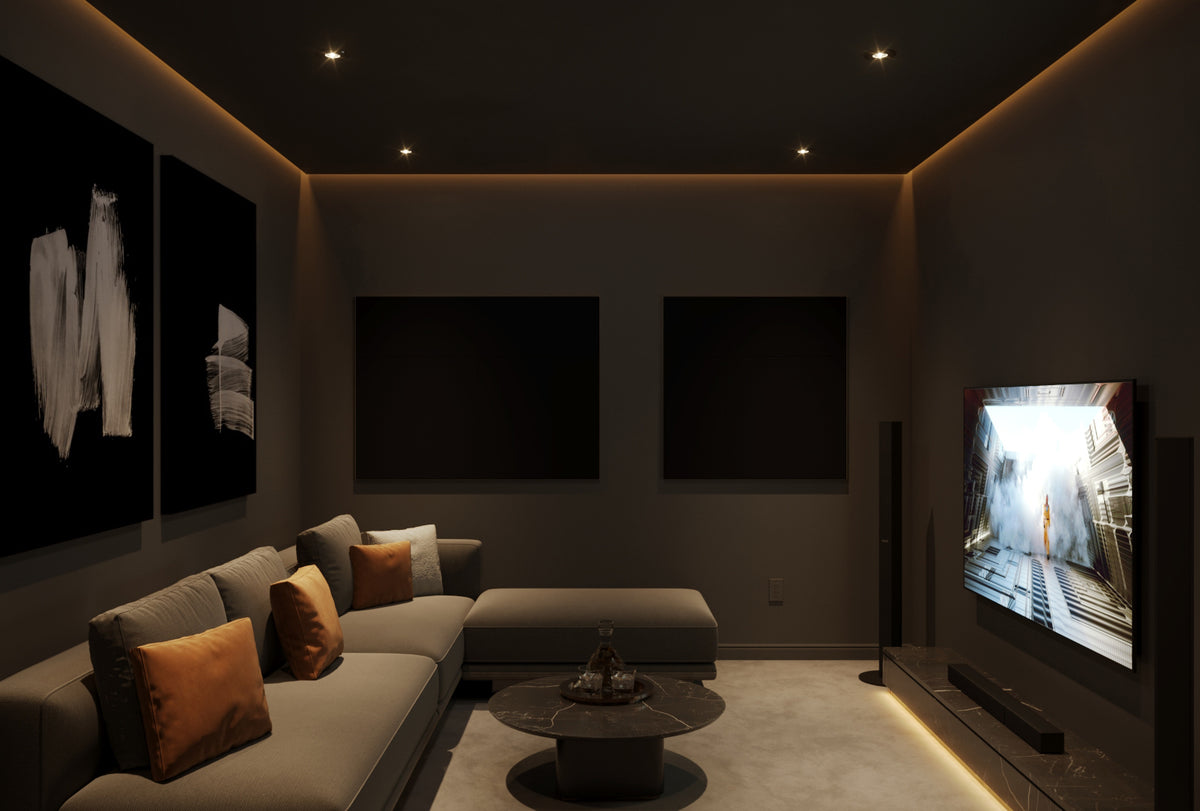
Acoustic treatment works best when each product has a clear job. Before choosing panel sizes, colors, or layouts, listen from the main seat and at least one secondary seat. Use familiar dialogue, music, and low-frequency scenes at a moderate level.
| What You Notice | Likely Room Issue | First Step |
|---|---|---|
| Dialogue loses detail or sounds smeared | Early reflections arriving soon after the direct sound | Treat priority side-wall and rear-wall reflection zones |
| The room rings or stays lively after loud scenes | Too much reflective surface and excessive decay | Add distributed broadband absorption |
| Bass is boomy in one seat and weak in another | Room modes, speaker placement, or low-frequency buildup | Review seating and subwoofer placement before adding Bass Traps |
| Movies can be heard through a closed door | Sound transfer through gaps or the door assembly | Evaluate door sealing and soundproofing |
Home theater acoustic treatment controls sound inside the room. Soundproofing reduces sound transfer into or out of it. Adding more wall panels will not seal a leaking door or isolate the room structure.
Finalize The Theater Layout Before Placing Panels
Speaker and seating locations define the reflection paths. Moving the sofa, changing the screen wall, or adding a second row after installation can shift the areas that need treatment.
Confirm these elements first:
- Main listening position and any secondary seats
- Front, center, surround, and height speaker locations
- Subwoofer locations
- Screen or television position
- Doors, windows, lighting, and equipment access
In a single-seat room, a first-reflection point can be fairly specific. In a theater with several seats, it becomes a wider reflection zone. The goal is a balanced result across the seats that matter, not a perfect result in one chair and a compromised room everywhere else.
Where To Place Acoustic Panels In A Home Theater
Side Walls
The side walls between the front speakers and the seating often create strong early reflections. These reflections can reduce image precision and make dialogue harder to follow. The mirror method is a useful starting point: from a listening seat, move a mirror along the wall and mark the area where a front speaker becomes visible.
For multiple seats, repeat the check from the primary listening positions and treat the combined zone. This is usually more useful than clustering every panel around one seat.
The Wall Behind The Seating
The rear wall can return a strong reflection toward the audience, especially when the seats are close to it. Broadband absorption is often the practical choice in shorter rooms. A larger theater may use a more varied plan, but the correct approach depends on the listening distance, available depth, and desired room character.
The Front Wall
Treatment behind or near the front speakers can reduce front-wall reflections and help the soundstage feel cleaner. In rooms with an acoustically transparent projection screen, treatment may be concealed behind the screen, provided it does not obstruct speaker output, ventilation, or equipment access.

The Ceiling
The ceiling can create a strong reflection between the speakers and seating, particularly in rooms with hard floors or limited wall space. Ceiling Treatments can control that path while leaving the walls available for screens, artwork, lighting, or surround speakers.
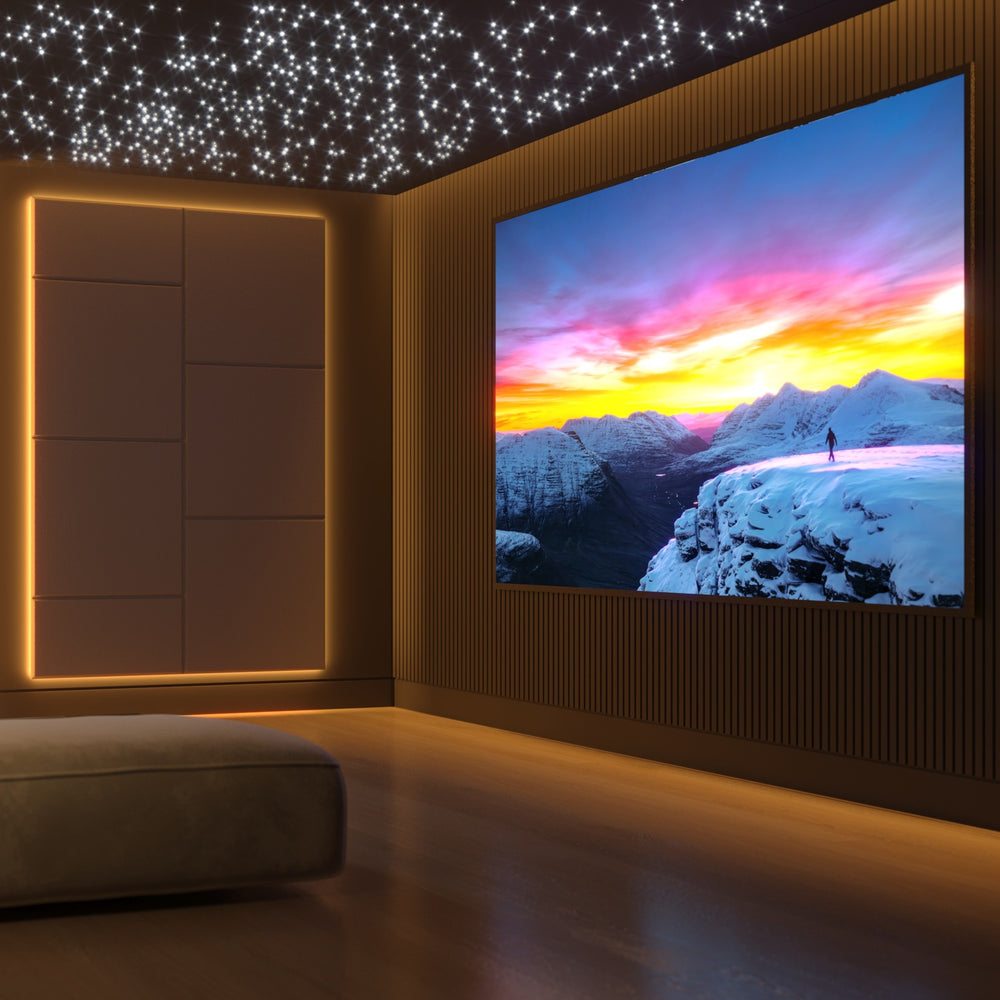
The speaker format matters. Upward-firing Dolby Atmos speakers intentionally use the ceiling as a reflection surface. In that setup, overhead treatment should be coordinated so it does not block the intended path. With direct-radiating or in-ceiling height speakers, the treatment layout can be planned around the speaker positions. If you are considering an illuminated overhead feature, review Acoustic Star Ceiling Panels for Home Theaters before finalizing the ceiling layout.
Corners And Low Frequencies
Low frequencies behave differently from speech and high-frequency reflections. If bass remains boomy, slow, or inconsistent after seating and subwoofer placement are reviewed, Overtone Bass Traps may be appropriate in the room's corners or other high-pressure areas.
Bass Traps are not a requirement for every theater. The recommendation changes with the room dimensions, subwoofer system, listening positions, and the frequencies causing the problem.
How Many Acoustic Panels Does A Home Theater Need?
There is no responsible fixed number based only on whether a room is called small, medium, or large. Panel quantity depends on the exposed surface area, room proportions, panel dimensions and construction, furnishings, speaker layout, and the number of seats being supported.
Start with the highest-confidence reflection zones, then expand only when listening tests show that the room still has excessive decay or an untreated reflection path. For a complete quantity-planning method, read How Many Acoustic Panels Do I Need?
Ceiling treatment and Bass Traps should be evaluated separately from the general wall-panel estimate. They solve different problems and may require different mounting locations or product depths. Use the acoustic panel thickness guide when comparing wall-panel depth separately from ceiling and bass treatment.
Choose The Overtone Solution By Room Need
| Room Need | Recommended Path | Why It Fits |
|---|---|---|
| A guided, coordinated theater setup | Home Theater Solutions | Organizes treatment by room scale and level of coverage |
| Clearer dialogue and shorter room decay | Overtone Acoustic Panels | Provides straightforward broadband absorption at priority reflection zones |
| Visible treatment that supports the interior | Acoustic Art Panels or Wallscapes | Turns necessary wall coverage into artwork or an architectural feature |
| Audible overhead reflections or limited wall space | Ceiling Treatments | Adds absorption above the listening area when the speaker format allows it |
| Persistent low-frequency buildup | Overtone Bass Traps | Targets bass behavior after placement issues have been reviewed |
| Sound leaking through the theater door | Soundproofing | Addresses transfer paths that ordinary acoustic panels do not seal |
Plan A Media Room Differently From A Dedicated Theater
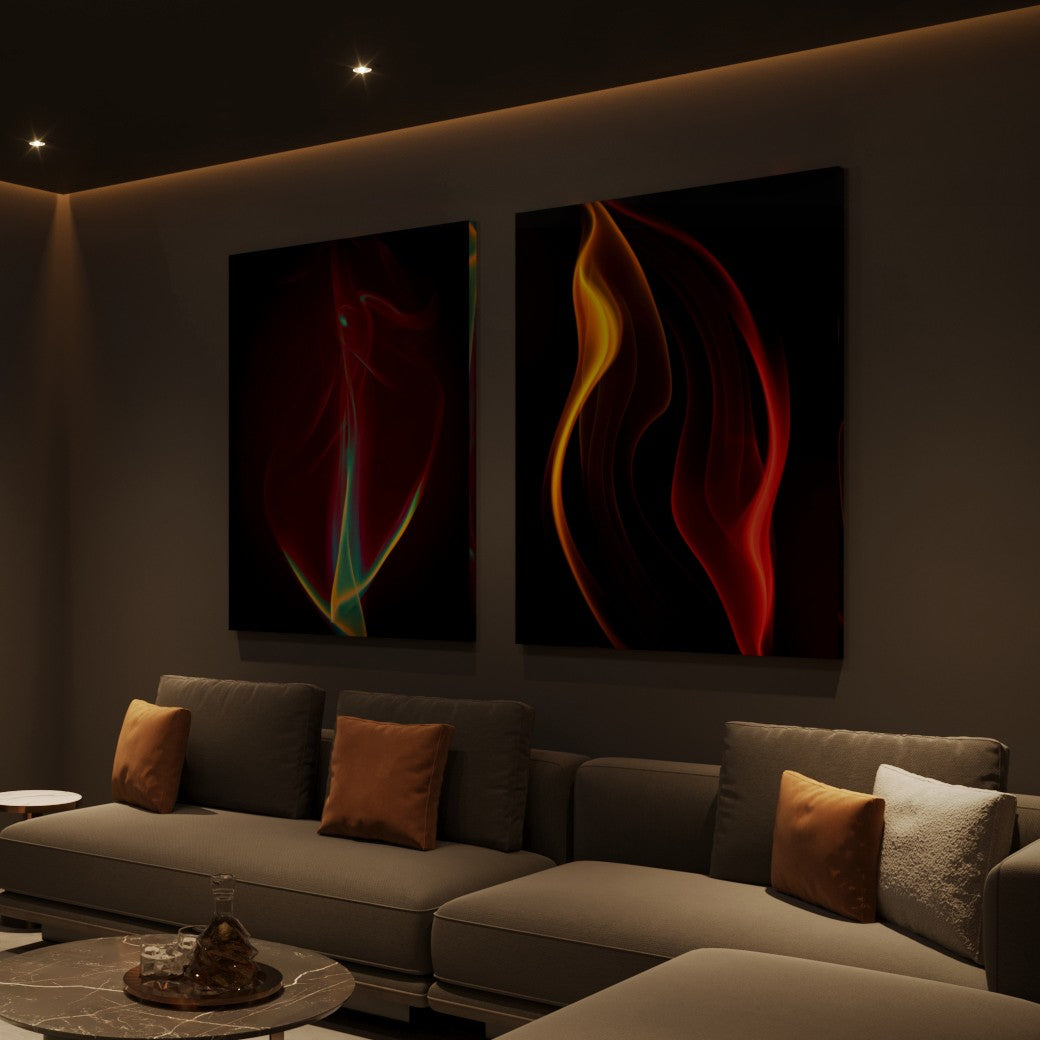
A shared living space usually has more furnishings, openings, and visual constraints. The most effective treatment may need to function as part of the interior, which is where Acoustic Art Panels or Wallscapes can provide absorption without making the room feel like a technical studio.
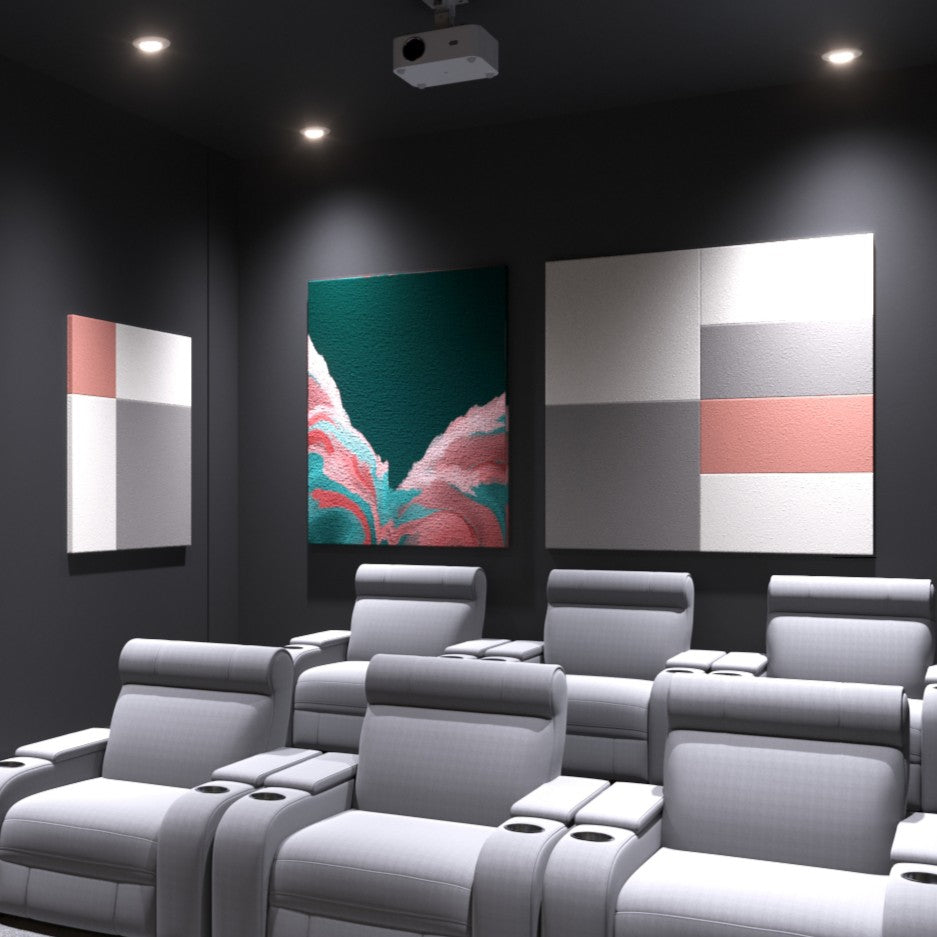
A dedicated theater usually supports more seats, higher playback levels, deeper bass, and a more complex speaker system. That increases the importance of distributed reflection control, low-frequency planning, and coordination around surround and height speakers.
Neither room should be treated by covering every open surface. A successful theater still needs a natural sense of space. The objective is controlled decay and consistent clarity, not a room that feels unnaturally dead.
Install In Stages And Listen Between Changes
- Record a short dialogue and music reference from the main seat.
- Install the highest-priority side-wall and rear-wall treatment.
- Replay the same references from each important seat.
- Add front-wall or ceiling treatment only where the remaining reflection pattern supports it.
- Address bass separately if low-frequency problems remain.
- Run the system's room-calibration process again after the physical treatment is complete.
Electronic calibration and physical treatment are complementary. Calibration can adjust level, timing, and frequency response, but it cannot shorten a long room decay or stop sound from passing through an unsealed door.
Common Home Theater Treatment Mistakes
- Buying panels before fixing the layout: treatment locations become guesswork if speakers and seating are still moving.
- Treating every surface the same way: walls, ceilings, and corners do not create identical problems.
- Optimizing only one seat: a multi-seat theater needs coverage across a reflection zone.
- Adding Bass Traps without diagnosing the bass: seating and subwoofer placement may be the first issue to correct.
- Expecting absorption to soundproof the room: privacy and transfer noise require isolation and sealing strategies.
- Skipping the final calibration: the room and system should be evaluated together after installation.
For more location-specific guidance, see Where to Place Acoustic Panels.
Home Theater Acoustic Treatment FAQ
What Does Acoustic Treatment Do In A Home Theater?
It reduces unwanted reflections and excessive decay so dialogue, effects, and spatial cues are easier to hear. It can also support more consistent listening across multiple seats when the layout is planned for the full audience area.
Where Should Acoustic Panels Go In A Home Theater?
Common priorities include side-wall reflection zones, the wall behind the seating, and selected areas near the front wall. Ceiling and corner treatment should be evaluated separately based on the speaker layout and the problem you hear.
How Many Acoustic Panels Does A Home Theater Need?
The quantity depends on the room dimensions, exposed surfaces, panel size, furnishings, speaker layout, and seating area. Use the room's priority reflection zones as the starting point rather than choosing a fixed number by room name alone.
Does Every Home Theater Need Bass Traps?
No. Bass Traps are appropriate when the room has persistent low-frequency buildup or uneven decay that remains after speaker, subwoofer, and seating placement have been reviewed.
Should A Home Theater Have Ceiling Treatment?
Only when overhead reflections are part of the problem and the treatment can be coordinated with the speaker system. Upward-firing Atmos speakers rely on a reflective ceiling path, so their intended reflection area should not be covered without a room-specific plan.
Do Acoustic Panels Soundproof A Home Theater?
No. Acoustic panels improve sound inside the theater. If sound is escaping through the door, evaluate Soundproof Door Kits, Door Gasket Sets, or Automatic Door Bottoms. Broader sound transfer through walls, floors, or ceilings may require construction-level isolation.
Build A Theater Plan Around Your Room
The right treatment plan follows the room: how it is used, where people sit, which surfaces are reflective, and whether the main issue is dialogue, bass, overhead reflections, or sound transfer. That is why a coordinated plan usually produces a better result than buying panels one surface at a time.
Explore Home Theater Solutions for a guided starting point, or request a Free Room Assessment when you want help matching treatment type, quantity, and placement to your theater.


