


Where to Place Acoustic Panels: A Room-by-Room Guide
If you are deciding where to place acoustic panels, begin with the relationship between the sound source, the listener, and the nearest reflective surfaces. Useful treatment follows the path of sound. It does not simply fill the largest empty wall.
The recommendation changes with the room. A Home Office needs clearer speech around a desk. A Podcast Studio needs controlled reflections around a microphone. A Home Theater needs stable sound across the seating position. The right layout starts with that use case.
Quick Answer: Where Should Acoustic Panels Go First?
Start with the surfaces returning the earliest or strongest reflections to the main speaking, listening, or recording position. In many rooms, that means:
- Side-wall reflection zones near the primary position
- The wall behind or opposite the listener, desk, sofa, or microphone setup
- The front wall when it returns sound from speakers or voices
- The ceiling above the active area when overhead reflections remain
- Corners only when low-frequency buildup is part of the problem
This is a planning order, not a universal formula. A furnished office, a glass conference room, and a mix room can prioritize different surfaces.

Start With The Room Problem, Not The Empty Wall
The first question to ask is what needs to improve. Panel placement should answer a specific room problem:
- Echo or difficult conversation: look for large hard surfaces around the speaking and listening area.
- Hollow calls or recordings: inspect nearby walls and the ceiling around the desk or microphone.
- Blurred music or theater sound: map the reflection paths between speakers and seats.
- A design-sensitive wall: identify which useful treatment zone is also visually prominent.
- Sound leaving through a door: stop and evaluate soundproofing rather than adding more wall absorption.
Once the symptom is clear, placement becomes easier. You can focus on the surfaces contributing to the problem instead of spreading a small amount of treatment across unrelated areas. If the cause is still unclear, start with the diagnostic guide Why Your Room Still Echoes.
Find First Reflection Zones On The Side Walls
In a speaker-based room, a first reflection is sound that leaves a speaker, bounces from a nearby surface, and reaches the listener shortly after the direct sound. These early reflections can reduce clarity and make stereo placement feel less stable.
The mirror method is a practical way to find the side-wall zones:
- Sit in the normal listening position.
- Ask another person to move a mirror along one side wall at speaker height.
- Mark the area where either speaker becomes visible in the mirror.
- Repeat on the opposite wall.
- Center the panels over those useful zones rather than treating the mark as a single exact point.

Sound spreads across an area, and the useful zone becomes broader when several seats or speakers are involved. In a Home Office or Podcast Studio, the same principle applies without a stereo setup: inspect the nearby walls that can return your voice to the working or microphone position.
Decide Which Surfaces Need Treatment
Side Walls
Side walls are a strong starting point for listening rooms, theaters, studios, and compact workspaces. Keep left and right placement balanced when stereo imaging matters. In conversation-driven rooms, treatment can be distributed more broadly along opposing hard walls rather than centered on one listening seat.
The Wall Behind The Listener
A rear wall can return sound quickly when the chair, desk, or sofa is close to it. Treatment behind the listening or working position can reduce that short return and improve clarity. In a larger room, the rear-wall plan may combine absorption with other acoustic strategies, so distance and room use matter.
The Front Wall
The front wall is the surface behind the speakers, screen, monitor, or person speaking. Treat it when that surface is a strong reflection path or when it needs to support the room's visual focal point. It does not automatically need more coverage than every other wall.
The Ceiling
A hard floor and hard ceiling create a separate vertical reflection path. Consider Ceiling Treatments when recordings remain boxy, the ceiling is low, wall space is limited, or a large conversation area sits beneath an uninterrupted hard surface.
Ceiling treatment should be evaluated separately from wall coverage. A wall-area estimate does not already account for a ceiling cloud or other overhead treatment.
Corners And Bass Buildup
Corners become important when the problem is uneven or boomy bass rather than speech echo alone. Low frequencies usually require thicker absorbers or dedicated bass control. Standard wall panels placed only for high-frequency reflections should not be expected to solve every low-frequency problem.
Acoustic Panel Placement By Room Type
Home Office
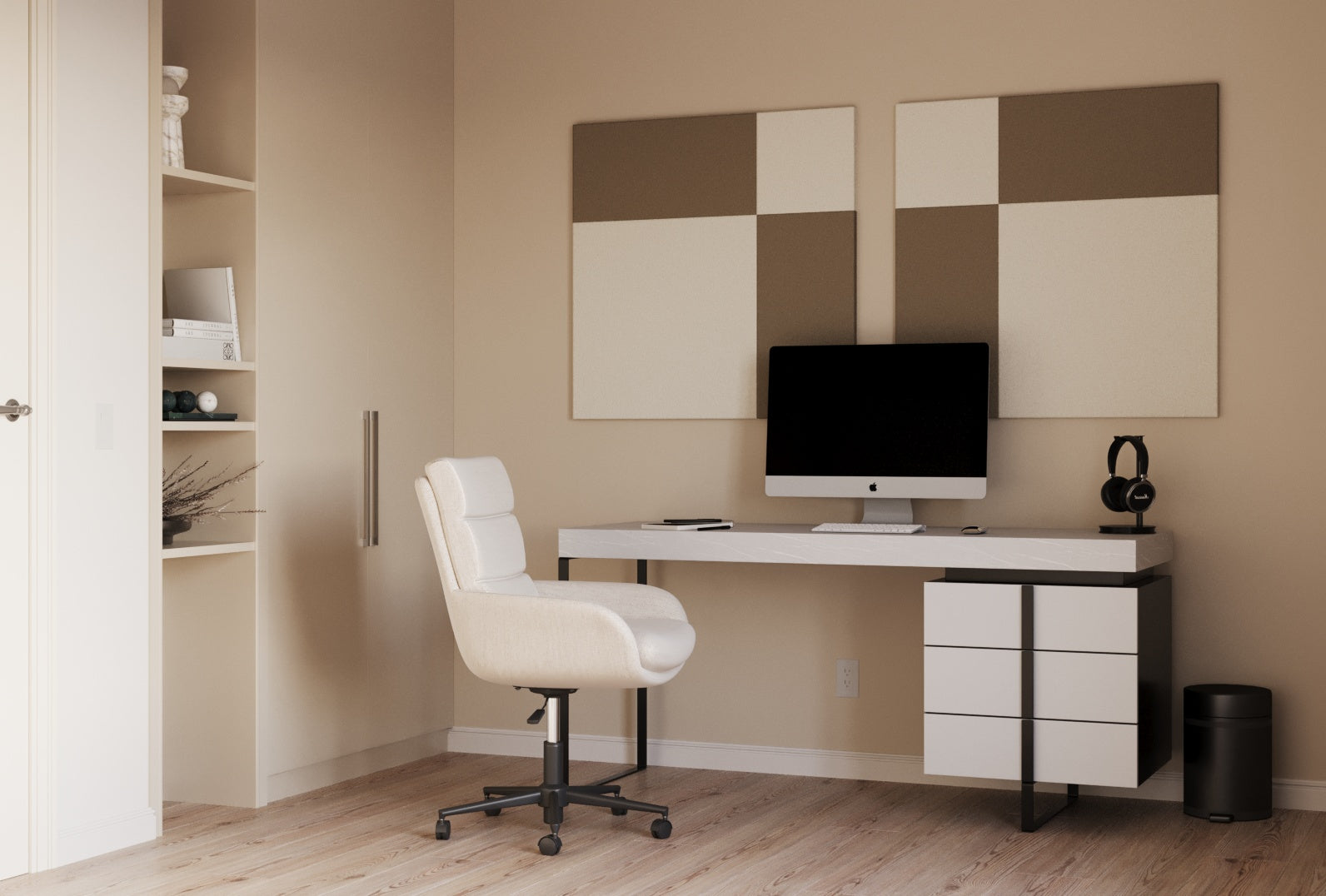
Start around the desk and call position. Inspect the side walls, the wall behind the monitor, the wall behind the user, and the ceiling above the desk. If the room needs a coordinated setup rather than individual product selection, the Home Office solution path can provide a more guided starting point.
Podcast Studio Or Voiceover Room
Place treatment around the speaker and microphone position, especially on nearby walls that produce a hollow or boxy return. The wall behind the speaker, side walls, and ceiling are common areas to evaluate. Microphone pattern and orientation also matter, so confirm the recording setup before finalizing placement. See Overtone's Podcast Studio guidance for the broader room plan.
Home Theater Or Listening Room
Begin with the side-wall first-reflection zones between the front speakers and the main seats. Then evaluate the rear wall and ceiling. Keep placement symmetrical around the primary listening position when possible. Overtone's Home Theater resources can help connect placement with the complete room setup. For the detailed listening-room plan, read Home Theater Acoustic Treatment.
Living Space
In a Living Space, useful placement must also work with furniture, windows, artwork, and circulation. The wall above or behind a sofa may be valuable, but only if it is part of an active reflection path. Design-forward treatment can make that useful surface feel intentional.
Conference Room, Restaurant, Or Shared Workspace
These rooms usually have several speakers and listeners rather than one fixed seat. Distribute treatment around the conversation zone and evaluate ceilings when long walls, glass, and hard floors keep speech active. The objective is consistent comfort and intelligibility across the occupied area. For dining venues specifically, see Restaurant Acoustic Treatment for wall-versus-ceiling choices and installation considerations.
How High Should Acoustic Panels Be Mounted?
For speech and listening problems, the useful panel area should generally overlap the seated or standing ear zone connected to the room's main activity. That does not mean every panel needs the same centerline.
- Center panels around the reflection zone rather than automatically aligning them with the ceiling.
- Use a larger panel or grouped layout when several seats must be covered.
- Align panels with furniture and architectural lines after confirming the acoustic area.
- Use mounting hardware appropriate for the panel weight and wall or ceiling construction.
A layout can be visually balanced without moving treatment away from the area doing the acoustic work.
How Many Acoustic Panels Do You Need?
There is no universal count. The answer depends on room volume, ceiling height, hard finishes, furnishings, panel dimensions, and how demanding the room use is. A furnished Home Office may need less distributed treatment than a glass conference room or critical listening space.
Start by covering the highest-priority reflection zones with meaningful panel area. Then listen again before expanding the layout. If the room still has broad reverberation rather than one localized reflection, it may need more distributed wall or ceiling absorption. For a worked quantity estimate using room dimensions and panel size, see How Many Acoustic Panels Do I Need?.
For a room-specific quantity and placement recommendation, use the Free Room Assessment rather than relying on a fixed panel count.
Choose The Product By Function And Visibility
- For straightforward echo control: place Overtone Acoustic Panels across the relevant wall reflection zones.
- For a guided setup: use Room Kits or the Home Office solution when you want coordinated coverage rather than individual selection.
- For a prominent wall that should look like artwork: use Acoustic Art Panels at the useful visible locations.
- For an architectural feature: consider Wallscapes or Acoustic Wood Slats when the room also needs texture, warmth, or a designed wall treatment.
- For overhead reflections: select Ceiling Treatments based on the ceiling structure and active area below.

A mixed plan is often appropriate. Acoustic Art Panels can occupy a focal wall while Overtone Acoustic Panels handle side-wall zones. Acoustic Wood Slats or Wallscapes can become an architectural feature while Ceiling Treatments address a separate overhead path.
Common Acoustic Panel Placement Mistakes
- Filling empty wall space first: placement should follow the source, listener, and reflective surfaces.
- Putting every panel on one wall: this can leave side-wall or ceiling paths active.
- Treating a reflection point as a tiny dot: useful coverage should account for the panel size, speaker spread, and number of seats.
- Ignoring the ceiling: overhead reflections are separate from the wall plan.
- Using standard panels for deep bass: low-frequency control often needs thicker treatment.
- Expecting absorption to stop sound transfer: acoustic treatment and soundproofing solve different problems.
Acoustic Treatment Is Not Soundproofing
Acoustic panels reduce reflections inside a room. They can improve speech clarity, listening comfort, recording quality, and acoustic fatigue. They do not seal gaps or prevent sound from passing through walls, floors, ceilings, or doors.
If the issue is privacy or sound leaking through a doorway, compare acoustic treatment and soundproofing. Overtone Soundproofing, including Soundproof Door Kits, Door Gasket Sets, and Automatic Door Bottoms, is the relevant path when the door is the transfer point.
Frequently Asked Questions
Where Should Acoustic Panels Go First?
Start with the surfaces returning sound to the main speaking, listening, or recording position. Side walls, the rear wall, the front wall, and the ceiling are common priorities, but the order depends on the room problem and use.
Should Acoustic Panels Go Behind Speakers Or Behind The Listener?
Either location can be useful. Treat behind the listener when a nearby rear wall sends a strong reflection back to the seat. Treat behind the speakers when the front wall contributes to the problem. Side-wall first-reflection zones may still be the higher priority in a stereo room.
How High Should Acoustic Panels Be Mounted?
Place the useful panel area around the reflection zone connected to seated or standing ear height. The exact height depends on the sound source, listener, room use, and panel dimensions.
Do Acoustic Panels Need To Go On The Ceiling?
Not in every room. Ceiling treatment becomes more relevant when the floor and ceiling are both hard, recordings remain boxy, wall space is limited, or the active listening or conversation area has a strong overhead reflection.
How Many Acoustic Panels Do I Need?
The count depends on room volume, surface materials, furnishings, panel size, placement, and use. Begin with meaningful coverage at the strongest reflection zones, then evaluate what remains or request a room-specific plan.
Will Acoustic Panels Stop Sound From Leaving The Room?
No. Acoustic panels improve sound inside the room. Sound transfer and privacy require a soundproofing plan that addresses gaps and the surrounding construction.

Plan Placement Before You Order
The right layout begins with a clear room problem, a primary use, and the surfaces returning sound to the people in the space. Once those are mapped, product type, panel size, quantity, and visual finish become much easier to choose.
Request a Free Room Assessment and share the room dimensions, ceiling height, photos, primary use, and what you hear. Overtone can help identify the useful wall and ceiling zones before you commit to a layout.


